
Exhibition Furniture Hire: What to Choose and How Much You Need
8 September 2026
Nobody in this industry publishes a straight answer, which is why you are on your fifth search. Here is what actually drives the number, three worked examples from our own estimator, and how to get a real figure for your stand in about a minute.
Ask most stand builders what a stand costs and you will get "it depends", followed by a request for your phone number. It genuinely does depend — but that is not a reason to keep the mechanics secret, and waiting two days for a callback to learn whether you are looking at roughly £2,000 or roughly £20,000 wastes everybody's time.
So here is how the arithmetic actually works. The figures below come from the same estimator that powers our online stand builder, so once you have read them you can put your own dimensions in and get a number on screen — no callback, no haggling.
Perimeter multiplied by height. The biggest single line in most estimates.
Each open side removes a wall. Island stands have less structure to build.
Taller walls cost proportionally more, and may need structural sign-off.
Flooring, lighting, printed graphics and any raised platform.
Stand cost is driven by surface area rather than by floor space, which is why the answer is less intuitive than people expect. A bigger stand is not automatically a more expensive one.
These come straight from our estimator, using carpet, lighting and — on the larger two — printed graphics.
A 3m by 3m shell-scheme-sized stand with one open side, carpet and lighting comes out at roughly £1,030. Step up to a 6m by 4m island with two open sides, carpet, lighting and printed graphics and it is roughly £3,400. A 9m by 6m with three open sides, same finish, is roughly £3,900.
That last jump is the interesting one. The floor area more than doubles between the second and third example, but the price barely moves — because three open sides means only one wall left to build, and walls are the single biggest line in the estimate.
Worth being precise about, because quotes from different suppliers often include different things and are almost impossible to compare as a result.
Walls, flooring, lighting, a raised platform if you want one, and graphics.
The organiser sells you the floor. That invoice is separate and often larger.
Hired separately, and priced for the full duration of your event.
Suppliers draw the line in different places, which makes comparison hard.
The structure is only part of your total. The show organiser charges for the space itself, and usually for power, and sometimes for rigging, waste removal or a compulsory contractor for certain trades. Those charges vary enormously between shows in the same building, let alone between venues.
Build constraints add cost too. An upper-level hall where everything arrives by goods lift caps component sizes and slows installation. A city-centre venue with tight vehicle windows costs more in crew time than a site where you drive to the hall floor. It is worth reading the exhibitor manual before you finalise a budget rather than after.
Ordered through the organiser, cheaper in advance, dear on the day.
Print is in the estimate. Someone still has to design what goes on it.
Cheaper than rebuilding, but it is a real line if you plan to reuse.
Frequently larger than the stand, and almost always forgotten.
None of these are the stand itself. All of them are routinely left out of the first budget and then found later, which is how a project that looked affordable stops being one.
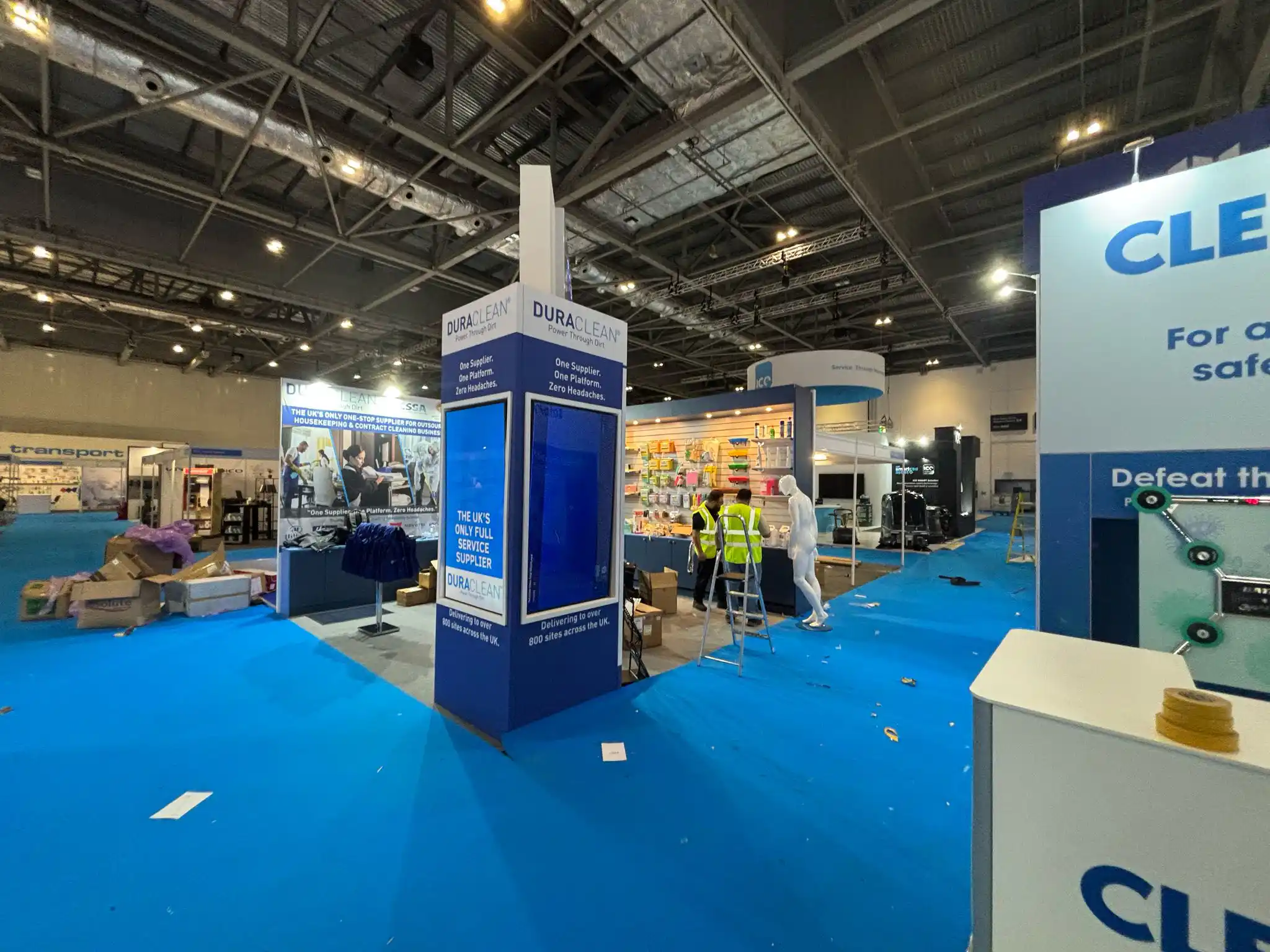
A shell scheme is the package your organiser sells: walls, a name board, usually a light and a socket. It is the cheapest way to exhibit and it looks like everyone else, because it is the same shell every other exhibitor has.
A custom stand is designed and built for you and typically used once, though we store and reuse them where the design allows. Modular sits between the two — a reconfigurable system that travels well and pays back across a calendar rather than a single show. If you exhibit two or three times a year, modular is usually the better arithmetic even though the first invoice is higher than a shell scheme.
There are sensible savings and there are false economies. These are the sensible ones — none of them make the stand look like you spent less.
Fewer walls to build, and better visibility for the same money.
It changes perceived quality more than any material upgrade.
One structure across three shows beats three separate builds.
A single strong message costs less to print and works harder.
Rather than asking you to guess from someone else's examples, our online stand builder gives you an instant estimate from your own dimensions — height, width, length, how many sides are open, and which finishes you want. No callback, no form-filling before you see a number.
We design and manufacture in our own workshop in Redditch and install across the UK, Ireland and Europe with our own crew. If the estimate looks workable, we can turn it into a proper quote with drawings; if it does not, at least you found out in a minute rather than a fortnight.
Previous Post
8 September 2026
Next Post
8 September 2026
Expert craftsmanship underpins every exhibition stand we build — combining precision construction, premium materials, and many years of hands-on experience to deliver stands that look exceptional and perform flawlessly on site.