Touchscreen, iPad and AV Hire for Exhibition Stands
8 September 2026
Most stand design inspiration is photographed empty, in perfect light, from an angle no visitor will ever stand at. These are ideas judged by whether they still work at 10am on a busy Tuesday.
Almost every stand that disappoints was designed to look impressive rather than to do a specific job. Those are not the same brief. A stand built to capture a high volume of light enquiries looks nothing like one built to hold six serious conversations a day with buyers who already know your name.
Before any visual work starts, it is worth being able to finish this sentence: the stand has succeeded if, by the end of the show, we have ___. Sometimes that is a number of conversations. Sometimes it is being taken seriously by three specific accounts. Sometimes it is simply not looking smaller than the competitor opposite. All three are legitimate, and each produces a different design.
Existing customers, cold prospects and press each need a different layout.
A stand sized for eight when four turn up looks empty all show.
A live demo needs power, space to stand back and somewhere to queue.
A stand designed once and reused across a season changes the whole budget maths.
None of these are about aesthetics, and all of them change the drawing. Answering them badly is the most expensive mistake available at this stage, because everything downstream inherits it.
A visitor does not approach your stand the way a camera does. They see it at an angle, in motion, from perhaps fifteen metres, while being spoken to by someone else. Most stand renders are produced from a viewpoint no human will ever occupy.
The practical test is simple. Print the design small, hold it at arm's length, and squint. If you cannot tell within two seconds what the company does, the design is relying on detail that will not survive the show floor. That usually means the headline is too long, the logo is doing work a message should be doing, or the strongest visual element is at eye level where the crowd will block it.
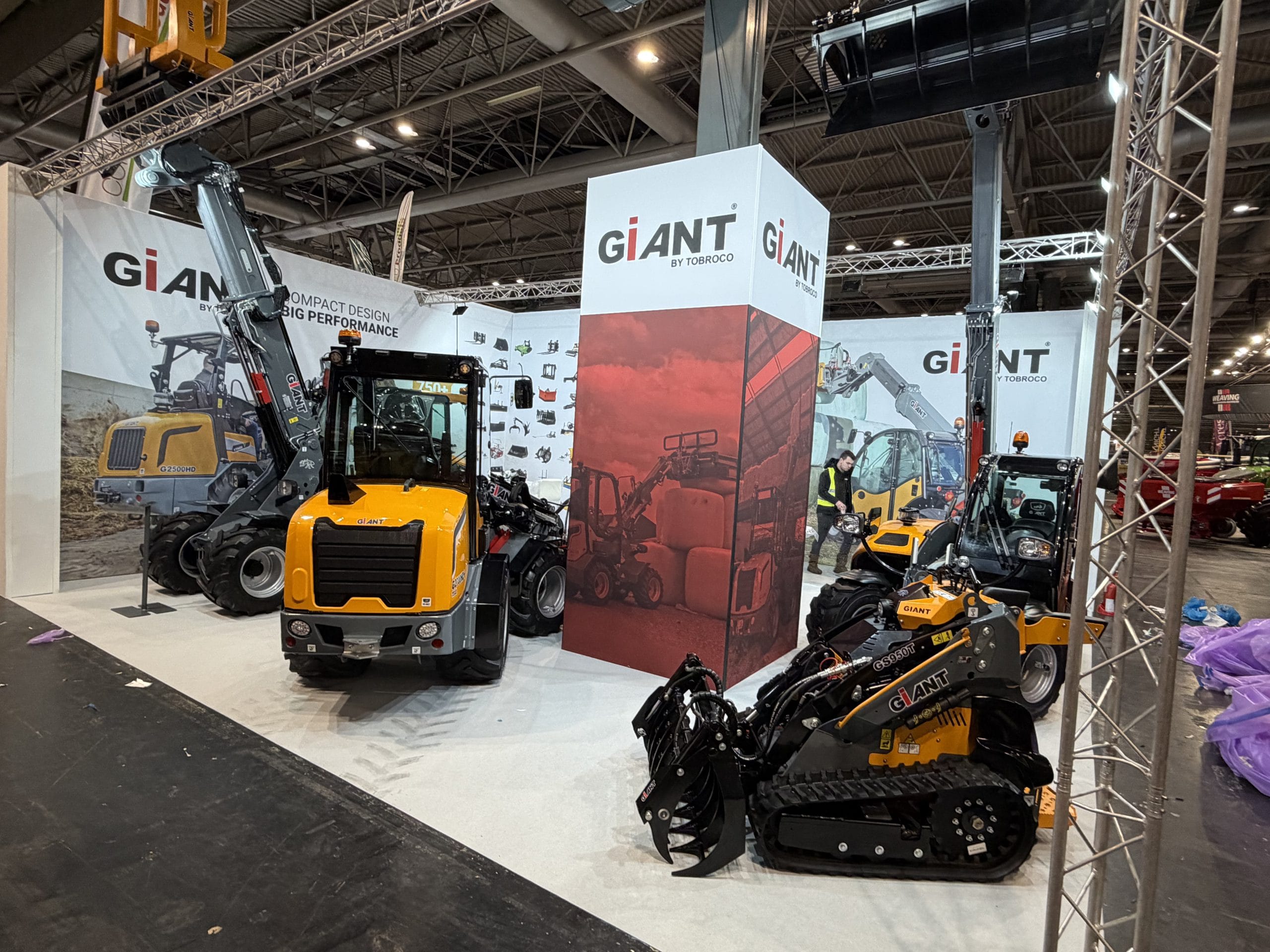
A large share of our work is agricultural and industrial machinery, where the exhibit is the hero and the stand exists to frame it. LAMMA is the clearest example — builds for SlurryKat, Joskin, Abbey Machinery, Ehrle, Same-Deutz-Fahr and Giant by Tobroco all had to work around equipment measured in tonnes.
Frame it, light it, and resist filling the space around it with structure.
Buyers want to see the back of it. Leave a metre they can circulate in.
Agreed with the organiser before build, not discovered on the day.
Coventry and Telford take vehicles into the hall, so exhibits arrive whole.
Look down almost any hall and you will see a floor of stands at roughly the same height, then a lot of empty air above them. That air is usually available, and it is the cheapest way to be visible from the far end of a hall.
The catch is that height rules come from your show organiser's exhibitor manual rather than the venue, and they vary between shows in the same building. Some halls also give you far more to work with than people assume — Manchester Central's main hall clears over twenty-six metres. Establish the permitted height before design, because retrofitting a taller structure means re-engineering, re-approving and paying twice.

Cutaways, working sections and materials people can handle beat a screen.
Anything that lets someone say "do you want to try this?" earns its cost.
Mounted low, they are read by nobody and blocked by everybody.
A physical sample outlasts a scanned badge in the memory.
Interactivity is worth doing when it either demonstrates something a photograph cannot, or gives your team a natural reason to start a conversation. It is worth skipping when it is a screen playing a video nobody stops to watch.

This is the single biggest layout choice, and it follows directly from the objective. An open stand with no barrier maximises the number of people who wander on. An enclosed or semi-enclosed stand with a defined entrance reduces footfall but raises the quality of who comes in, because stepping inside is a small act of commitment.
High-volume consumer shows generally reward open. Technical trade shows where you need a proper conversation, a demonstration and somewhere to sit usually reward zoning — an open front edge that draws people in, and a quieter area behind it where a real discussion can happen without shouting.
Small stands fail when they try to do everything a large one does at a reduced scale. They succeed when they do one thing unmistakably well. Constraints help here, if you let them.
A small stand with three messages communicates none of them.
Height costs floor space you do not have to buy.
It is a barrier, and on a small stand it is most of your floor.
Coats and boxes on show ruin a small stand faster than a large one.
Two identical stands, one lit properly and one relying on hall lighting, do not look like the same budget. Hall lighting is flat, overhead and unflattering — it is designed to illuminate a space, not to make anything look good in it.
Directional lighting onto the product, a lit graphic wall and something warm at the point where people stand and talk will do more for perceived quality than a more expensive floor finish. It is also one of the few upgrades that costs the same whether your stand is six square metres or sixty.

Nobody has ever walked onto a stand to read a timeline.
If it takes more than two seconds to read, it is not a headline.
Seating that faces the aisle invites people to sit, not to talk.
Any unlit part of a stand reads as closed, whatever is in it.
These come up repeatedly, and they consistently cost more than they return. None of them are catastrophic on their own, but each one quietly reduces how many useful conversations you have.
The gap between a good idea and a built stand is mostly practical: what the organiser permits, what fits through the access route, what can be installed in the time allowed, and what can be dismantled without damage so it can go out again next year.
We design and manufacture in our own workshop in Redditch and install across the UK, Ireland and Europe with our own crew, which means those constraints get considered while the design is still on paper rather than discovered during build-up. If you want a sense of cost before committing to anything, you can enter your stand dimensions in our online builder and get an instant estimate.
Previous Post
8 September 2026
Expert craftsmanship underpins every exhibition stand we build — combining precision construction, premium materials, and many years of hands-on experience to deliver stands that look exceptional and perform flawlessly on site.